Can You Sell Tickets Online With No Fees?
Not if you mean card payments. Every time someone pays by card, the card networks and the banks take a small slice, and nobody along the way is doing it for free. So when a ticketing site says "no fees", the cost hasn't vanished. It has been moved somewhere you're less likely to look.
That isn't always a con. But it's worth knowing where it went, because the cheapest-sounding offer and the cheapest offer aren't always the same thing.
Where the cost goes
There are only two places it can sit. It can be added to the buyer's total at checkout, so your audience pays a little on top of the ticket price. Or it can come out of your takings, so the buyer pays the price on the poster and you keep slightly less of it.
"No booking fee" often means the first is switched off and the second is quietly switched on. "Free for organisers" often means the audience is paying.
Whether the audience or the group should be the one paying is an argument in its own right, and we had a go at it in Booking Fees: Add Them On or Absorb Them?
How ticketing sites charge
Fees come in a few shapes, and one site can mix several of them. A percentage of the ticket price, a fixed amount per ticket, a fixed amount per order, a separate charge for card processing. The card processing charge is the one to watch. A headline rate that looks lovely and small can have a second percentage sat behind it in the small print.
The hardest pair to compare is per ticket against per order, so take one example. Say your tickets are £10. One site charges 50p a ticket, another charges £1 an order.
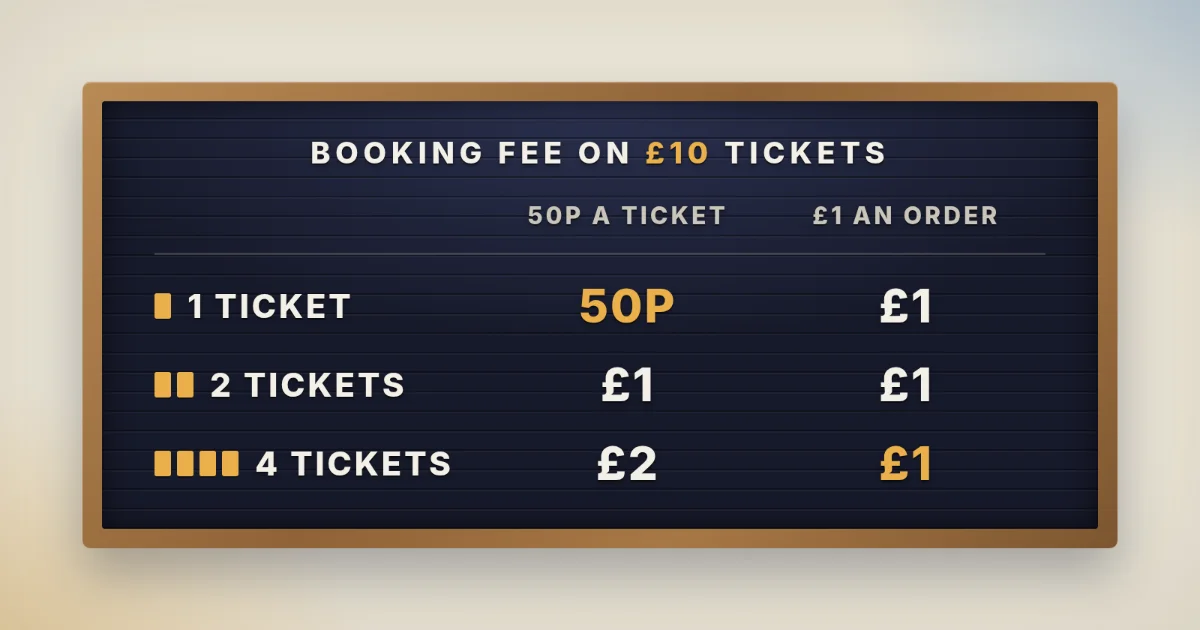
A couple buying two tickets pays £1 either way. Someone booking alone pays 50p with the first site and £1 with the second. A family of four pays £2 with the first and £1 with the second.
So which is cheaper depends entirely on how your audience buys. If they mostly come on their own, the per ticket fee wins. If they come as families and groups of friends, the per order fee wins, and the bigger the orders the bigger the gap.
Working out the real cost for your event
You already know the two things you need, your ticket price and how many tickets a typical order has in it. If you've sold online before, last time's orders will tell you. If you haven't, think about who's coming. A family show booked by parents, grandparents and children is a very different crowd from a comedy night that mostly draws couples.
Put that one typical order through every site you're considering, with every charge from the list above added in, and you get figures you can compare like for like. Then do it again for an order of one, because somebody always books alone, and see whether the answer changes.
The genuinely free routes
There are ways to sell tickets with no fees at all. Cash on the door. Bank transfer, with someone keeping a spreadsheet of who has paid. A cast member with a book of tickets and a biscuit tin.
They do cost something, just not money. Somebody has to match bank transfers to names, chase the ones that never arrive and answer "did you get my money?" in the week of the event. A seat reserved with nothing paid is an easy thing to forget, so you get no-shows. And with tickets going out from three different places, nobody has a running count of what's left, which is how two families turn up holding the same seats.
For a small, one-off event where the whole audience knows each other, that might be fine. For anything bigger the time adds up, and it always lands on the same two or three people.
How Time For A Show charges
Here comes the plug, I'll keep it short. With Time For A Show the booking fee is a percentage plus a fixed amount per order, not per ticket, and it covers card processing and running the site, so there's no separate card charge on top.
For each event you choose whether the fee is added at checkout or absorbed, coming out of your takings so the buyer pays exactly the ticket price. Sales you take yourself through the Box Office page, whether that's cash, a card terminal, a bank transfer or pay on the door, carry no booking fee and come off the same count of seats as everything sold online.
Work out the cost for your event with your own ticket price and a typical order.